Paradise Palms: Inside Las Vegas' First Master-Planned Community and Its Mid-Century Legacy
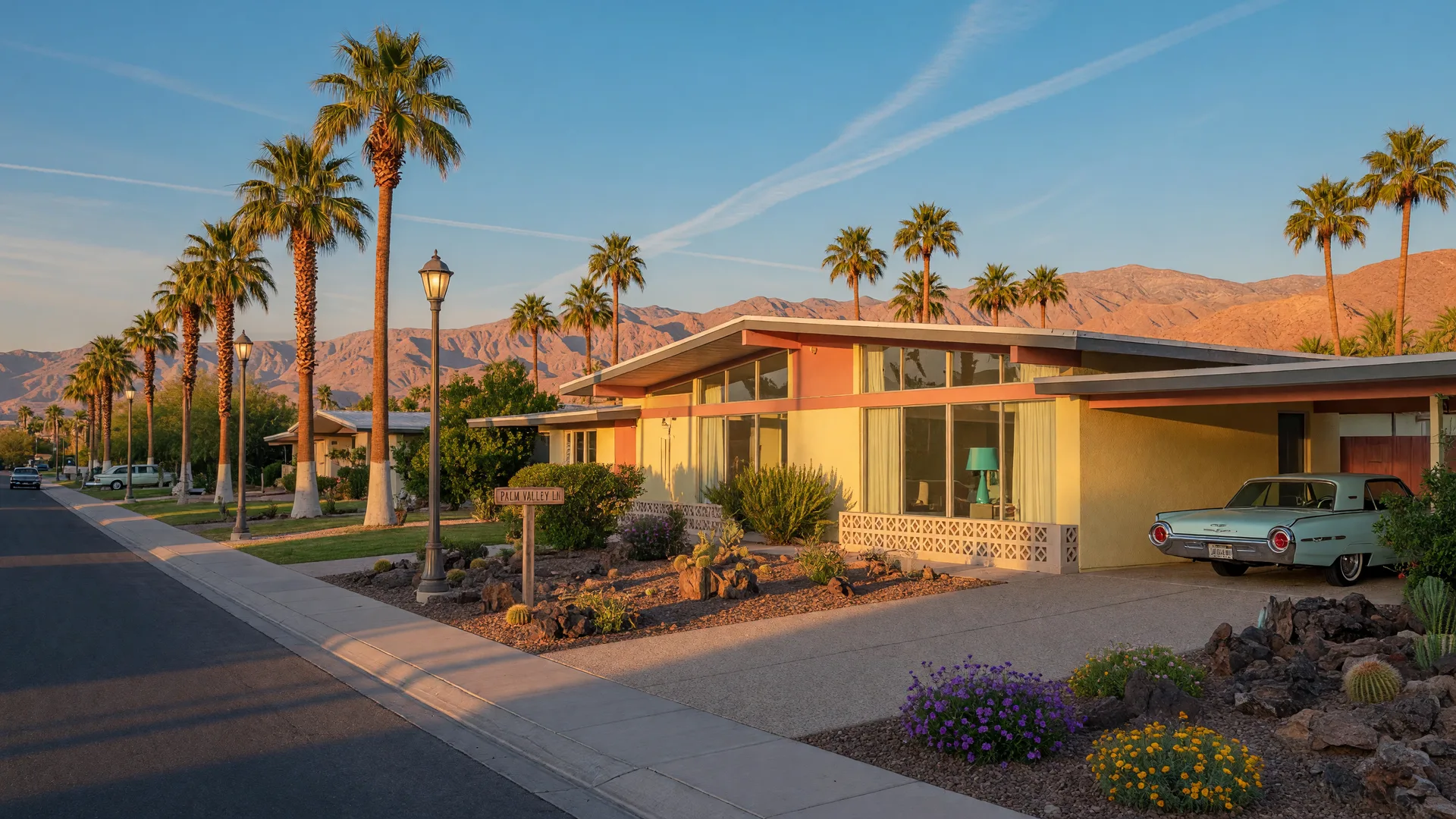
Not every story in Las Vegas is neon lights and brand-new builds. Paradise Palms is the quiet, architectural one, and it just happens to be the neighborhood that launched modern master-planned living in the valley. This guide tells the reported story of how it started, who designed the houses, the stars who passed through, and what its historic overlay actually means for homeowners today. Everything historical is stated plainly, everything sourced is labeled reported, and the education stays general because rules change and your situation is specific.
Quick Takeaways
- Reported: Paradise Palms is widely considered Las Vegas' first master-planned community, started in 1960 by Irwin Molasky and Merv Adelson.
- Reported: The homes were designed by Palm Springs architects Dan Palmer and William Krisel with signature butterfly and folded-plate rooflines.
- Reported: It earned Clark County's first historic overlay in 2017 and was expanded in 2022 to roughly a thousand homes.
- Education: Historic overlay status protects the neighborhood's character through exterior design review set by Clark County.
- Education: Most homes are modest mid-century gems, not mansions, and buyers buy for architecture and location.
What Is Paradise Palms?
Paradise Palms is a mid-century modern housing community in Las Vegas, located generally between downtown Las Vegas and the city's University District, near Desert Inn Road, the former Boulevard Mall site area and the Las Vegas National Golf Course. If that location sounds like the heart of old Las Vegas, it is: this is the part of town where the city's early modern era took shape, not the newest subdivisions out on the valley's edge.
What makes the neighborhood noteworthy is that it is widely described as Las Vegas' first master-planned community. The phrase gets thrown around a lot now that master plans dominate the valley, but Paradise Palms is reported to have done it first, decades before the big planned communities most people associate with Las Vegas. And unlike many of those newer places, its appeal is architectural: a whole neighborhood of genuinely designed mid-century homes, set down at a time when the city was just beginning to boom.
When Was Paradise Palms Built and by Whom?
Development of Paradise Palms began in 1960 under Paradise Development, the firm founded by Irwin Molasky and Merv Adelson, with a reported groundbreaking on March 21, 1960. The two developers were part of a small group of builders and investors who helped shape modern Las Vegas, and Paradise Palms is reported to be connected to that era of growth, the same circle behind projects like Sunrise Hospital and the commercial energy around the old Boulevard Mall years.
The homes themselves were built in phases from 1960 into the mid-1960s, reported at roughly 1960 to 1965, with additional builders added to the community around 1963. So the neighborhood was not built all at once by a single crew. It grew in stages, which is part of why the streets vary slightly and why the homes, though sharing a design language, are not identical boxes. That phased, genuinely planned approach is exactly what earned Paradise Palms its reputation as the valley's first master-planned community.
Who Designed the Homes in Paradise Palms?
The architecture of Paradise Palms is reported to have been designed by Southern California architects Dan Palmer and William Krisel, who are known for their post-and-beam tract homes in Palm Springs. If you have ever admired the clean, low-slung desert modernism of that era, you already have a feel for the style: open floor plans, wide roof overhangs and a strong connection between indoors and outdoors.
The reported signature details at the time included flat, folded-plate, butterfly, pyramid and open-gable rooflines, decorative concrete block, and clerestory windows that let light in high up the walls. Original home sizes were reported to range from roughly 1,200 to 2,200 square feet, with most under 1,800. In other words, these are mostly modest, thoughtfully scaled homes, not showpiece mansions. That is part of their charm and part of why they appeal to people who care about design and character more than square footage.
Why does that matter? Because Paradise Palms is a genuinely designed neighborhood rather than a row of cookie-cutter houses. The rooflines, the block, the way the streets are laid out, it all adds up to a cohesive look that is rare to find all in one place, especially in a city where much of the housing stock is newer and more uniform. For anyone who appreciates mid-century modern architecture, walking these streets is a treat.
Who Lived in Paradise Palms?
Paradise Palms is known historically for its entertainer and celebrity residents. Reported past residents and famous stayovers include Cher, Don Rickles and Diana Ross, among others. That roster makes sense given where the neighborhood sits, close to the entertainment and hospitality world of old Las Vegas, and its place in local lore near Desert Inn Road and the golf course.
I will keep this section brief and factual, because the stories are fun but the important thing is what the neighborhood means now. That a stretch of mid-century homes once drew performers and celebrities is part of why Paradise Palms holds a special place in Las Vegas history. Today, its legacy lives on mostly in its architecture and its protected status, not in any glamour that remains on the street.
What Does the Historic Overlay Mean for Homeowners?
Here is the piece buyers and owners ask about most, and it deserves a careful answer. In 2017 Paradise Palms received its first Clark County historic landmark and overlay designation covering about 216 homes, reported as the first such historic designation in Clark County. Then in April 2022, the Clark County Commission expanded the overlay by about 747 homes to roughly a thousand homes total, reported as making it the largest historic neighborhood overlay in Southern Nevada.
So what does being inside an overlay actually mean for a homeowner? Generally, and this is education rather than legal advice, a historic overlay typically adds design-review protection over exterior changes and demolitions, while leaving interior changes alone. In plain English, the idea is to keep the outside of the neighborhood looking true to its history, while homeowners keep the freedom to update the inside of their own home.
But the exact rules are not uniform, and they are set by the county's historic preservation program. That is the honest part I want you to hear clearly: I am describing how these overlays generally work, not quoting Paradise Palms' specific current guidelines. If you buy or own here, verify the current rules directly with Clark County before you plan any exterior work.
A few education points worth separating
The overlay does not create an HOA. Owners in Paradise Palms still follow whatever standard property rules apply to the neighborhood, but the historic overlay is a county designation, not a homeowners' association.
Overlay status is part of the neighborhood's character and marketing appeal, but by itself it does not change your property taxes. Any tax question should be checked with the Clark County Assessor, not assumed from the overlay or from an article like this one.
I will say it plainly, because accuracy matters more than good news: historic preservation rules and tax treatment change, and every situation is individual. Confirm current overlay guidelines with Clark County and any tax questions with the Assessor before you make a decision based on either.
What Should Buyers Know About Paradise Palms?
If you are considering a home here, the honest headline is this: expect a range of conditions. Some Paradise Palms homes have been lovingly restored and updated, while others remain much closer to their original mid-century state. There is no single rule of thumb, and what you will find depends on the specific house, which is exactly why looking in person matters so much in a neighborhood like this.
Second, the neighborhood is renovation-friendly in spirit, but exterior design review applies because of the historic overlay. That is not a reason to avoid the area; it is a reason to go in knowing the outside of the home is part of what makes it special, and that exterior changes go through a county review process. Interiors remain yours to update.
Third, the location is a practical one, convenient near the University District and the eastside, with easy access to the roads and services that have long made central Las Vegas a liveable place. And fourth, the historic designation adds character and protection to the neighborhood. As for resale, that is an individual question, not a guarantee: some buyers are drawn specifically to a protected historic home, and every situation differs. I do not make promises I cannot back up, so the honest advice is to look at the specific home, understand the specific rules, and weigh what fits you.
Frequently Asked Questions About Paradise Palms
Q: What is Paradise Palms?
A: Paradise Palms is a mid-century modern housing community in Las Vegas, located generally between downtown Las Vegas and the city's University District, near Desert Inn Road, the former Boulevard Mall site area and the Las Vegas National Golf Course. It is widely described as Las Vegas' first master-planned community, with development beginning in 1960.
Q: When was Paradise Palms built and by whom?
A: Development of Paradise Palms began in 1960 under Paradise Development, founded by Irwin Molasky and Merv Adelson, with a reported groundbreaking on March 21, 1960. The homes were built in phases from 1960 into the mid-1960s, roughly 1960 to 1965, with additional builders added around 1963.
Q: Who designed the homes in Paradise Palms?
A: The architecture was designed by Southern California architects Dan Palmer and William Krisel, known for post-and-beam tract homes in Palm Springs. Reported signature details at the time included flat, folded-plate, butterfly, pyramid and open-gable rooflines, decorative concrete block and clerestory windows, with original home sizes reported from roughly 1,200 to 2,200 square feet, most under 1,800.
Q: What does the historic overlay mean for homeowners?
A: In 2017 Paradise Palms received its first Clark County historic landmark and overlay designation covering about 216 homes, reported as the first such historic designation in Clark County. In April 2022 the Clark County Commission expanded the overlay by about 747 homes to roughly a thousand homes total, reported as making it the largest historic neighborhood overlay in Southern Nevada. Generally, an overlay adds design-review protection over exterior changes and demolitions while leaving interiors alone, but exact rules vary and are set by Clark County's historic preservation program. It does not create an HOA and does not by itself change taxes. Buyers should verify current guidelines with Clark County and taxes with the Assessor.
Q: What should buyers know about Paradise Palms?
A: Buyers should expect a range of conditions, from lovingly restored to fully original, and should understand that exterior design review applies while interiors remain free to update. The location is convenient near the University District and the eastside, and the historic designation adds character and protection. Resale implications are individual, so talk through them with a local agent before you decide.
Related Resources
- Communities & Neighborhoods articles, the home of this guide on the blog.
- The community hub: Las Vegas, Henderson and beyond, with neighborhood-by-neighborhood depth.
- The Las Vegas community guide: understanding Las Vegas neighborhoods, from Paradise Palms to the newest master plans.
- Trends & Treasures articles: design, character and the details that give a neighborhood its personality.
- The buying hub: the full sequence of buying a home in Las Vegas.
- The buying process: the step-by-step from offer to close.
Ready to See Paradise Palms for Yourself?
Whether you collect mid-century design or simply want a unique slice of Las Vegas history, I would be happy to show you what Paradise Palms has to offer. My job is to help you understand a neighborhood, its rules and its character before you make a decision, not to pressure you into one. A walk through the streets tells you more than any description, and a conversation is the natural next step.

Written by
Sandy Margolin
REALTOR · Certified AI Agent · 36+ years in real estate · Former Appraiser · Nevada license S.0072707.
More about SandyWant the honest picture of a Las Vegas community?
The reported history in this article is a good start, but the specifics of a neighborhood, its rules and whether it fits you are best sorted out in a conversation. That is the kind of help I enjoy most.