3D-Printed Homes in Las Vegas: What's Real, What's Hype and What's Next
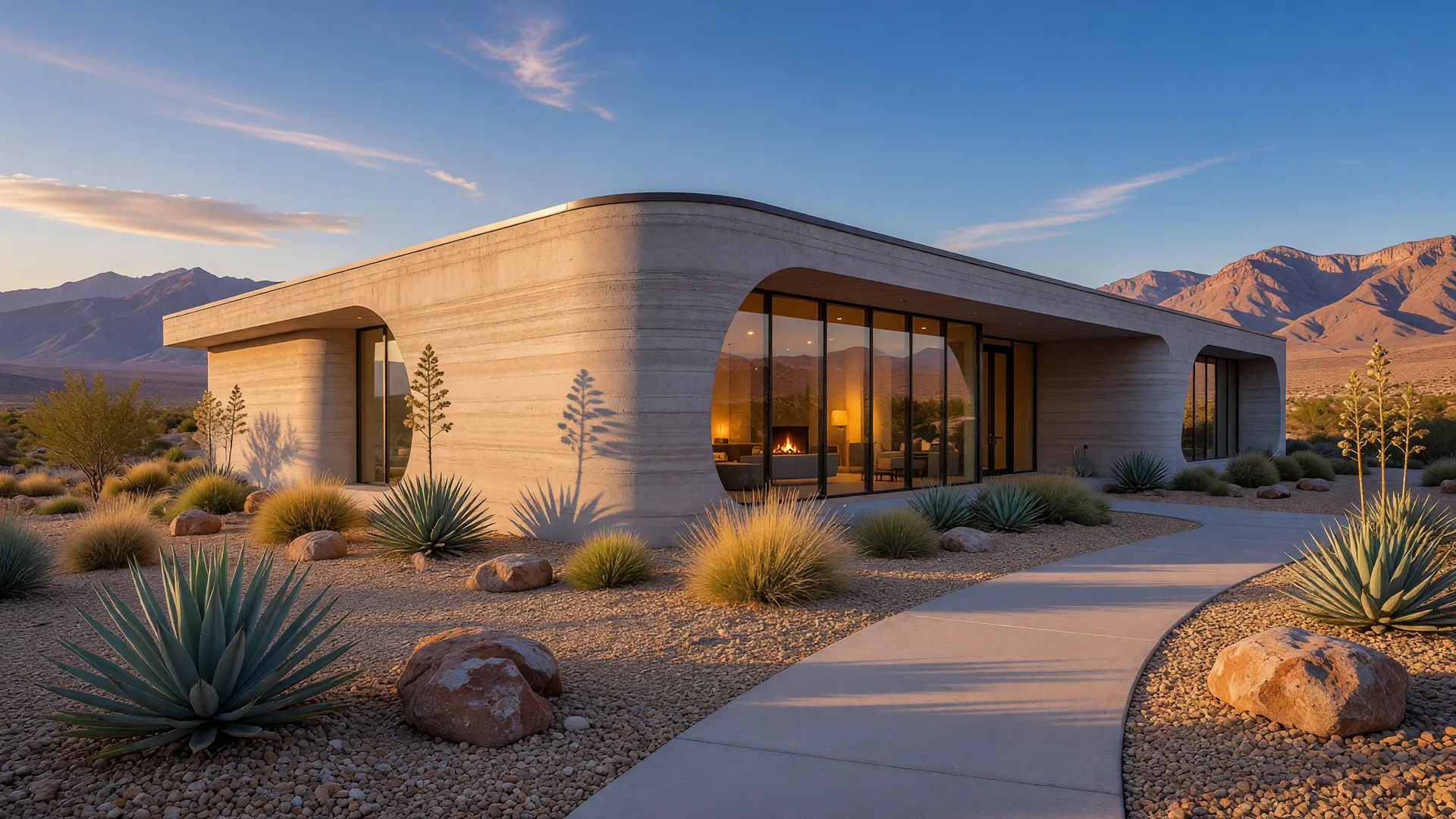
3D-printed homes make great headlines, and those headlines usually leave out the fine print. The honest reality in Las Vegas is more interesting and more grounded: most local projects are pilot-scale, and the biggest questions are practical ones about financing, appraisal, insurance and resale. This is a straight look at what is actually happening here, what the technology really does and does not change, and what buyers should be asking before they get swept up in the novelty.
One note on sourcing before we get into it. Everything factual below is labeled reported, and any claim a company makes about speed, cost or size is attributed to that company and treated as a claim, not as a verified fact. The education sections explain how the technology works and the questions worth asking; they are not guarantees about any specific project.
Quick Takeaways
- Reported: Las Vegas' first 3D-printed home is planned for the historic Scotch 80s neighborhood, with construction reported to begin fall 2026.
- Reported: A 2024 West Las Vegas project was reported to break ground with 3D-printing technology, though company claims about speed and cost are not verified facts.
- Education: Most local 3D-printed work is pilot-scale, not mass production.
- Education: The biggest questions are practical: financing, appraisal, insurance and resale value.
- Education: Modular factory-built homes, like those from North Las Vegas-based Boxabl, are a different technology entirely from on-site 3D printing.
Reported at a glance
Park Circle Residence (Constructiv3D)
Reported as planned to be Las Vegas' first 3D-printed home, in the historic Scotch 80s neighborhood, with construction reported to begin fall 2026. The company bills it as the largest 3D-printed home in the U.S., a company claim, not a verified fact.
West Las Vegas OZ fund project (2024)
Reported to have broken ground on the area's first 3D-printed homes using Alquist 3D technology. Speed and efficiency gains were company claims, not independently verified.
Boxabl (North Las Vegas)
A factory in North Las Vegas that builds modular units, often described as smart or manufactured housing. That is a different technology from on-site 3D printing, and Boxabl's cost and speed figures should be treated as company claims.
Las Vegas Sun, March 2025
Reported coverage of how 3D-printed and factory-built homes are being pitched nationally as one answer to the housing shortage, including a quote from the acting HUD secretary under the former administration.
Cleora, Salida, Colorado (reported, context only)
A 55-acre planned community reported to be testing 3D-printed construction at community scale. Useful context, but it is in Colorado, not Las Vegas.
All items reported as of this writing; details and dates change. Company claims are attributed to the company that made them and are not endorsed or verified here.
Are There 3D-Printed Homes in Las Vegas?
Let's start with the headline item, because it is genuinely interesting and it gets simplified every time it is repeated. Reported: Constructiv3D's Park Circle Residence project is planned to be Las Vegas' first 3D-printed home, sited in the historic Scotch 80s neighborhood, with construction reported to begin fall 2026. At build time the company billed it as the largest 3D-printed home in the United States. That billing is the company's own claim, reported here as a claim, not as an independently verified record.
Before that, there was the 2024 project in West Las Vegas. Reported: an OZ fund project broke ground on what was described as the area's first 3D-printed homes, using Alquist 3D technology, with the companies involved making claims about speed and efficiency gains. Those are company claims, and this article does not verify them or treat them as facts.
Two more reported items put all of this in context. The Las Vegas Sun reported in March 2025 on how 3D-printed and factory-built homes are being pitched nationally as one answer to the housing shortage, including a quote from the acting HUD secretary under the former administration. And reported in August 2026, the same paper covered Cleora, a 55-acre planned community in Salida, Colorado, built specifically to test 3D-printed construction at community scale. That last one matters because of where it is not: the largest community-scale test reported so far is not in Las Vegas. It is happening in Colorado, and Las Vegas is still in the pilot phase.
How Does a 3D-Printed Home Actually Get Built?
Strip away the futuristic imagery and the process is easier to understand than the headlines suggest. A large printer, usually a gantry frame or a robotic arm, extrudes layers of a concrete-based material on top of each other, stacking walls the way a cake gets its layers. The walls are printed on site, at the property. Everything else, the roof, the foundation work around it, plumbing, electrical, insulation for cavities, windows, doors and finishes, is done by conventional trades using conventional methods.
That division is the key to thinking clearly about the technology. What it is genuinely good at is real and worth respecting:
- Curved and sculpted walls. Forms that would be expensive or awkward with conventional framing are natural for a printer.
- Design freedom. The machine does not care if a wall plan is repetitive or one of a kind, which opens up custom design at a lower labor cost per unusual detail.
- Fast wall erection. Once the setup is dialed in, walls can go up much faster than stick framing, though setup, site work and finishes still take real time.
And here is what the technology does not change, which is the part the marketing tends to skip:
- Site work and foundations. Grading, utilities and the foundation still happen the conventional way, before any printing starts.
- Mechanicals and finishes. Plumbing, electrical, HVAC, roofing, trim and painting still go in by hand, and that is a large share of any home's cost and schedule.
- Permits, inspections and codes. A novel wall system still has to pass the same local review process as any other home.
The word "printed" makes it sound like the whole house comes out of one machine. In practice, printing replaces one part of the construction sequence, the walls, and leaves most of the rest untouched. That is not a criticism. It is the honest way to compare what the technology really saves.
Can You Finance or Insure a 3D-Printed Home?
This is where the practical questions live, and they are rarely in the promotional material. The education here is simple: lenders and appraisers decide value and loanability using evidence, and for 3D-printed homes that evidence base is thin.
Financing. Lenders underwrite against comparable sales, appraisal support and established construction methods. With almost no 3D-printed homes sold or refinanced in this market, a lender's automated systems and an individual underwriter both have very little to lean on. That does not mean financing is impossible; it means it is likely to be case-by-case, with more questions, different documentation and possibly different loan programs than a conventional resale would require.
Appraisal. As a former licensed residential real estate appraiser, I can tell you how this typically plays out in a way the brochures do not. Appraisers build value from comparable sales: recent, similar properties in the same market. When a home type has no meaningful set of comparables, the value opinion becomes harder to defend, and that uncertainty flows straight into how much a lender will lend against it. With a handful of pilot projects and no resale history, appraisers simply do not have the data they normally rely on.
Insurance. Insurers underwrite risk, and an unusual wall system with limited claims history raises questions an insurer has to answer. Coverage will likely be available, but expect more underwriting questions, possibly different carrier options, and premiums that reflect the lack of track record.
None of this is a guarantee in either direction. The point is that financing, appraisal and insurance all move in lockstep with market evidence, and the evidence for 3D-printed homes in Las Vegas barely exists yet. Anyone promising otherwise is selling something.
What About Resale Value and Timelines?
Two more honest realities belong in the same conversation.
Resale. There is no resale track record for 3D-printed homes in Las Vegas, because there is no meaningful inventory of them to resell. Value at resale is a function of what a future buyer will pay, and with no sales history, that future number is genuinely unknown. The people buying a pilot home today are accepting that uncertainty, whether they know it or not. That is not a reason to dismiss the projects; it is a reason to go in with eyes open.
Timelines. A printed wall system does not skip the rest of the build. Permitting follows the same local processes as any other new construction, inspections still happen at each stage, and the finish work still takes time. I am deliberately not inventing construction durations here, because every project is different and honest numbers only exist project by project. The general education point is the one that matters: 3D printing is a new way to build walls, not a shortcut around the system that protects buyers.
One more piece of healthy skepticism, offered the way I would offer it to a friend. Novelty claims deserve the same scrutiny as any claim in real estate. "First," "largest," "fastest" and "cheaper" are all testable, and in this corner of the market most of them have not been tested by anything yet. Ask who made the claim, ask what evidence supports it, and ask what happens if it turns out to be wrong. That is the whole reality check.
What's the Difference Between 3D-Printed and Modular Homes?
This mix-up is everywhere in headlines, and it is worth untangling because the two technologies raise very different questions.
Modular (or factory-built) homes are assembled indoors, in a factory, and shipped to the site in finished sections that get set on a foundation and connected. It is a mature industry with decades of history, established financing paths, and a much deeper pool of comparable sales and appraisals behind it. North Las Vegas-based Boxabl works in this lane: it builds its units in factory space here, and 2026 local news coverage (reported) discussed what supporters call the Las Vegas small-house project using this kind of modular housing. Boxabl is not a 3D-printed home, and its cost and speed figures should be read as company claims.
On-site 3D printing, as described above, extrudes walls in place at the property. It is newer, and it has almost none of the established financing, appraisal or resale infrastructure that modular construction has built up.
Both technologies are real, and both get lumped together by the word "printed" or "prefab" or "innovative." The education takeaway is to find out exactly which one you are looking at before you compare costs, financing or anything else, because the building realities and the lending realities differ substantially.
Should You Buy a 3D-Printed Home?
Here is my honest position, stated plainly. New building technology is exciting and worth watching. If 3D-printed construction matures, it could genuinely change what new construction costs and how fast it gets built, and Las Vegas with its volume of new communities is a natural place for that to play out eventually.
But for most buyers today, a conventionally built home remains the practical choice, and that is not a dig at the technology. It is simply that the support system around a home, financing, appraisal, insurance, resale comparables, service trades, future repairs, has decades of maturity for conventional construction and almost none for 3D-printed homes. Buying a pilot home means carrying those unknowns yourself.
If you are genuinely interested, ask the right questions and go in informed. If the novelty is the appeal, weigh it against what you are giving up in evidence and track record. And if you are considering a modular home, evaluate it on its own terms, which are much more established, rather than through the 3D-printing headlines.
For my part, I keep an eye on what is actually available and listable in this space. When something real and sellable shows up, I will tell you what the comparable evidence does and does not support, the same way I would on any other home.
Let's Talk Through New Construction and Innovation Questions
If you are exploring new construction, a 55+ community build, or anything on the cutting edge of how homes get built here, a conversation is a practical next step. I have spent more than 36 years in Las Vegas real estate and about 20 of those as a licensed residential appraiser, so I am comfortable walking through what the market evidence supports, what it does not, and what questions to ask before you commit. No pressure, no hype, and I will tell you what I would want someone to tell me.
Frequently Asked Questions About 3D-Printed Homes in Las Vegas
Q: Are there 3D-printed homes in Las Vegas?
A: Not yet, in the sense of homes you can tour or buy. Reported: Constructiv3D plans what would be Las Vegas' first 3D-printed home in the historic Scotch 80s neighborhood, with construction reported to begin fall 2026 and the company billing it as the largest 3D-printed home in the United States, a company claim. Reported: a 2024 West Las Vegas project using Alquist 3D technology broke ground, with the companies making their own claims about speed and efficiency. Most local 3D-printed work is pilot-scale, and modular factory-built homes like those from North Las Vegas-based Boxabl are a separate technology entirely.
Q: How does a 3D-printed home actually get built?
A: A large printer, usually a gantry or a robotic arm, extrudes concrete in layers like a cake, and the walls are printed on site. Roofs, mechanicals, plumbing, electrical and finishes are done by conventional trades. The technology is genuinely good at curved walls, design freedom and putting walls up quickly; it does not change site work, foundations, inspections or permits.
Q: Can you finance or insure a 3D-printed home?
A: The practical answer is that it is early. Lenders and appraisers have limited experience with 3D-printed homes, and appraisers determine value from comparable sales, which barely exist for this type of home. Insurance underwriting may also have questions. None of this is a guarantee that financing or insurance is unavailable; it means every case is handled individually and you should expect more questions than a standard checklist would produce.
Q: What's the difference between 3D-printed and modular homes?
A: They are different technologies that headlines often lump together. On-site 3D printing extrudes walls in place at the property. Modular homes, including the factory-built units made by North Las Vegas-based Boxabl, are assembled indoors and shipped to the site in sections, an approach with decades of history. The two have different building realities, financing considerations and resale footprints. Boxabl units are modular housing, not 3D-printed homes.
Q: Should you buy a 3D-printed home?
A: For most buyers today, a conventionally built home remains the practical choice, mainly because 3D-printed inventory barely exists here, lender and appraiser experience is thin, and there is no resale track record yet. The technology is worth watching, not dismissing; it may matter for new construction in the coming years. If you are considering anything unconventional, work with someone who will tell you honestly what the market evidence does and does not support.
Related Resources
- Trends & Treasures articles, the home of this reality check on the blog.
- The new-construction guide: how buying a new build works, step by step.
- Why bring your own agent to a new build: the registration rule that protects you.
- The buying process: pre-approval through closing, in order.
- The Southern Nevada new-home market: where new construction is heading right now.
- Las Vegas communities: the neighborhoods where new homes are actually being built.
- Las Vegas Lifestyle & Relocation articles: what it is really like to live here.
- Schedule a call with Sandy: 30 minutes, straight answers, no pressure.
This article is education, not an endorsement of any 3D-printing or modular company, and not a guarantee about financing, insurability or resale of any specific home type. Company claims are attributed to the companies that made them and should be verified independently before you rely on them.

Written by
Sandy Margolin
REALTOR · Certified AI Agent · 36+ years in real estate · Former Appraiser · Nevada license S.0072707.
More about SandyCurious about new construction, or just want a straight answer?
The article reads the headline. The conversation reads your situation, with current numbers and no pressure. Thirty minutes is usually all it takes.