Home Office for Sellers: Show It Honestly
If you work from home, the room where you work can quietly help your home sell, or quietly make it harder. In more than 36 years in real estate, including my years as a licensed residential real estate appraiser, I have watched the home office go from an afterthought to a feature buyers actually ask about. This guide is the plain-English version: how to present the space honestly, make it photograph and show well, know the difference between a true office and a flex space, and decide what about your setup should stay with the house.
One room can carry real weight
Here is the honest version: a home office does not sell a house by itself. Location, condition, size, price and what the market is doing do most of the work. But the office is one of the few rooms that has grown more important over the last several years, because how people work changed. More buyers than ever picture themselves taking calls, getting through a workday or running a small business from home, and they look at that spare room through a different lens than they used to.
So the goal is not to turn the sale into a work-from-home pitch. The goal is to present the space accurately, make it look its best without spending a fortune, and avoid overselling what is really there. When a buyer walks in and the office shows well, the home appeals to a wider range of people. When it is cluttered, dark and cramped, it quietly shrinks the pool.
This guide stays general on purpose. I am not going to tell you to spend a certain amount or promise a certain return, because the right answer depends on your home and your market. What I can do is show you how to think about the room with an appraiser's eye: what matters, what does not, and how to be honest with buyers about what the space truly is.
The office as a selling feature
These are the things buyers tend to register when they walk into a home office, and each one is easy to describe honestly in a listing. None of them justifies a higher price on its own, but together they help the room show its best to the widest range of potential buyers. Think of this as the short list of what is usually worth mentioning, not a shopping list for new furniture.
A room with a door
Privacy is the first thing buyers with real work-from-home needs check for. A room with a door that closes means calls stay quiet, papers stay put and the rest of the household keeps moving. A true enclosed room carries more weight than a desk tucked into a corner of the living space.
Natural light
Rooms with natural light photograph brighter and feel larger, and light matters most in an office because it is where people sit for hours. If the room has a good window, show it. If it does not, bright, layered artificial light does a surprising amount of the work.
Video-call ready
Many buyers now do their own work on video calls, so they notice a room that would frame well on camera: a clean background, a tidy desk, no cords crawling across the floor. You do not need to stage it like a studio, just make it the kind of background someone would be glad to sit in front of all day.
Practical power
Buyers quietly check whether the desk can sit where they want it without extension cords running around the room. Outlets in sensible places, a clean setup behind the desk and working wiring are small things that make a room feel finished rather than improvised.
Lighting that flatters
Good lighting does more for a room than almost any renovation. A bright overhead, a lamp on the desk, no flickering bulbs, consistent light for the photos. When a room photographs clearly and warmly, buyers can actually picture themselves in it.
Present these honestly and the office becomes a room that helps the whole house. Oversell a cramped nook as a premium home office and buyers will feel the gap the moment they walk in. Accuracy is the strongest staging tool I know.
True office, or flex space?
Part of my job as a former appraiser is calling a space what it actually is, and that matters here. A room truly set up as a home office is not the same as a dining room with a desk in it, and buyers can tell the difference. Before you list, decide what the space really is and describe it that way. Run the room through these five questions and you will know how to present it.
- 01
Does it have a door and walls?
A true office is usually an enclosed room: four walls, a door that closes and a sense of separation from the rest of the home. A nook in a great room or a desk against a wall is useful, but it is not the same feature. Call it what it is, and buyers who need genuine quiet will trust you from the first photo.
- 02
Will the standard furniture fit?
Picture what a typical buyer would bring: a desk, a chair, a file cabinet or bookshelf, maybe a second monitor. If the room fits that comfortably, it functions as an office. If the only way to use the space is your exact custom setup, it is more of a flex space, and an honest listing says so.
- 03
How does it show in the listing?
The listing sets the expectation. If you call a room an office, make sure the photos and the floor plan agree. If you call it a den, a library or an extra room, buyers know what that means too. The mismatch is what hurts: a buyer who expects a private office and walks into a pass-through will start questioning everything else they read.
- 04
Would a buyer pay for it as described?
As an appraiser I am used to asking what a feature is worth to the market. A true dedicated office is part of the floor plan and shows that way. A flex space is still genuinely useful, but buyers will value it as the room it is. Honest labeling does not cost you anything, and it saves you a disappointed walkthrough.
- 05
What will the next buyer actually use it for?
The room may end up as an office, a guest room, a nursery or a workout space in the new owner's life, and that is fine, because most rooms serve more than one purpose. Your job is not to guess the next owner's life. It is to describe the space clearly so they can picture their own version of it.
There is no one-size-fits-all answer here, and that is the point. Describing the room accurately is what protects you: the right buyers show up with the right expectations, and nobody walks away disappointed by a feature that was never really there.
What actually matters for resale
In my years as a licensed residential real estate appraiser, I learned that value comes from the fundamentals: location, size, condition, age and layout. An appraiser does not add a premium because a seller staged a pretty office, and nobody expects one. The office does its work inside the larger question of how the whole floor plan functions for the way people actually live.
What the office does well is make the floor plan feel current. Homes are bought by people living real lives, and a usable workspace is part of how a home serves those lives now. A clean, honest, well-presented office helps the whole home read as well cared for and thoughtfully arranged, and that supports the sale in a real, if quiet, way.
So treat the office like any other room in your pre-listing routine. Clean it, declutter it, fix what is obviously tired and let it photograph honestly. You are not building a new feature, you are presenting the one you have. Homes sell when what buyers see matches what the market tells them the house should be.
Show it well without the remodel
Most sellers do not need to spend money to make a home office show well, and they certainly do not need a renovation. The highest-impact work is subtraction, light and order, and almost all of it is free. Here is the checklist I would run through with you before the photographer arrives.
- 01
Clear the desk down to the essentials
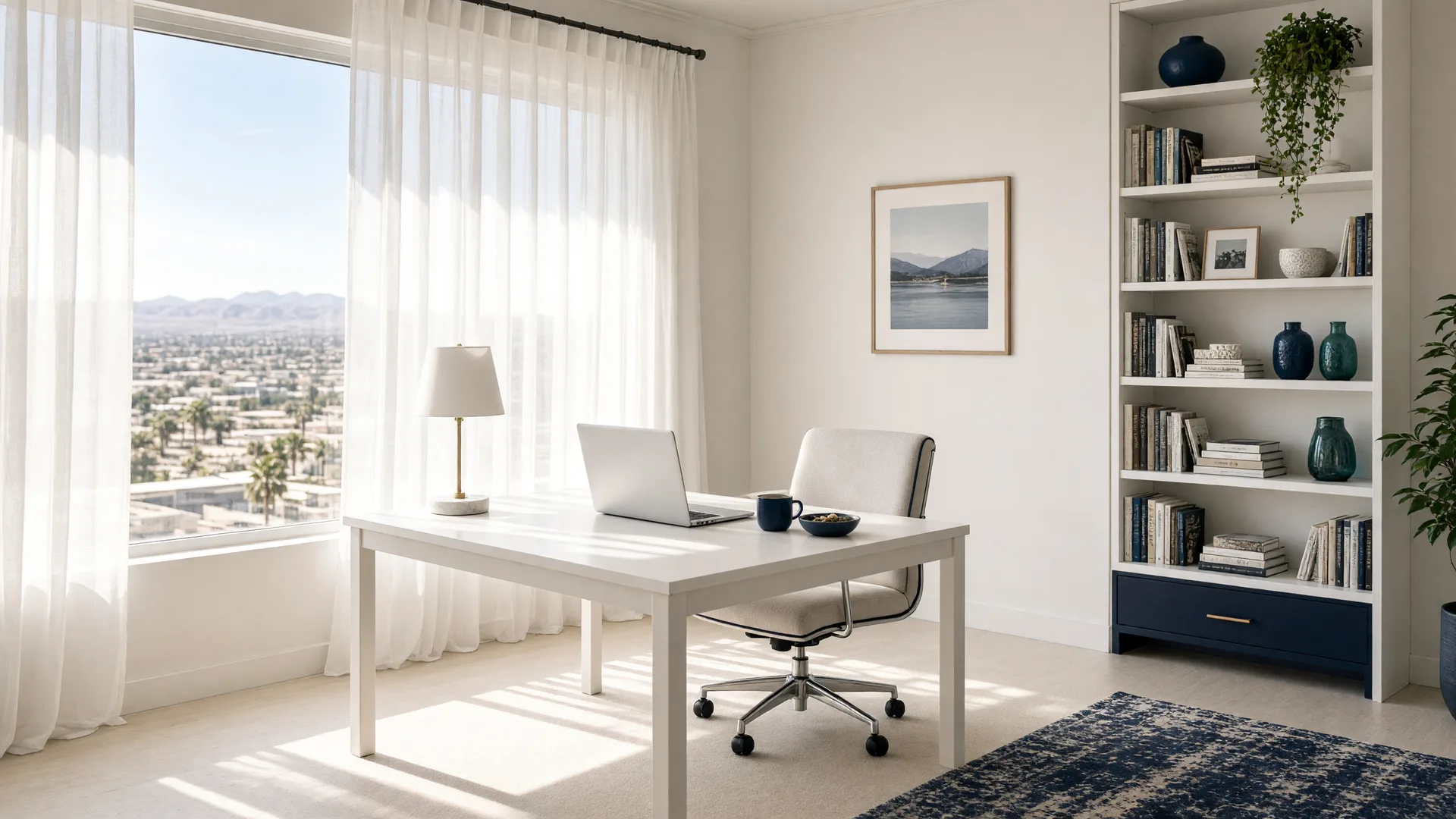
A desk with a laptop, a lamp and one small personal item photographs like a place people work. A desk covered in papers, cables and coffee cups photographs like clutter, no matter how clean the rest of the house is. Box the rest and put it out of sight until after the sale.
- 02
Make the background video-ready
The wall behind the desk is what buyers see in photos and what a future owner will face on their own video calls. A clean wall, a simple piece of art or a tidy shelf reads well and costs nothing. Skip anything busy, personal or half-finished, and the room will show its best.
- 03
Turn on every light
Switch on the overhead and the lamps before the photographer arrives and before every showing. Light is the cheapest upgrade in real estate. Open the blinds all the way on showing days, because buyers want to see any office at its brightest hour.
- 04
Tuck away the technology
Loose cords, routers, printers and backup drives make a room feel like a utility closet. Route cords along desk legs or behind furniture, move the printer to a drawer or closet and hide the Wi-Fi gear where it does not compete with the room. The space should read as a place to work, not a place to store equipment.
- 05
Let the chair fit the desk
A good office chair in the photos tells buyers the room is actually used for work. A mismatched dining chair or an empty desk says the opposite. Borrow a sensible chair if you have to, and square it up at the desk so the room reads as ready to use.
- 06
Declutter the shelves and the floor
Office storage feels honest when it is tidy. Thin out the bookshelves, clear stacked papers and boxes off the floor, and leave enough open space for the room to feel walkable. Buyers need room to picture their own things in there, not yours.
Work the list top to bottom and the room will photograph like a space someone would happily spend eight hours in, because that is exactly what it would be. You do not have to furnish it like a magazine, just make it clean, bright and believable.
Equipment, built-ins and wiring
This is the part sellers forget until they are deep in contract: some of the office conveys with the house and some of it is your personal property. Most buyers assume the desk, chair and filing cabinets go with you. Built-ins, wall-mounted shelving and wiring are usually a different story. Decide early, say it plainly and save everyone the awkward conversation later.
- 01
Know what is attached to the house
As a general rule, items that are attached to the walls, floor or structure tend to stay with the home: built-in desks or shelving, wall-mounted cabinets, installed lighting and structured wiring. Loose furniture and freestanding equipment are typically personal property. Your agent and the purchase agreement define the exact line, so ask before you assume anything.
- 02
Say what conveys in the listing
If a built-in desk, a wall of shelving or a specialty light stays with the home, say so in the listing and the disclosures. That sets an accurate expectation, and it lets a buyer who was planning to bring their own pieces plan around what is already there.
- 03
Say what does not
There is nothing wrong with taking your sit-stand desk, your office chair and your monitor arms with you. Just do not present a feature you plan to remove. Ambiguity at the showing turns into a negotiation at the worst possible time, late in the transaction.
- 04
Be upfront about wiring and outlets
If you added network drops, extra outlets or conduit, describe them accurately: where they run, what they connect and whether they are active. A little honest detail reads as a well-maintained home, and it saves the buyer's electrician from guessing after closing.
- 05
Leave it clean and working
Whatever stays should be clean, working and ready for the next owner. Clear the built-ins, dust the shelving, test the outlets and leave a short written note about anything the new owner will wonder about. A tidy handoff is the quiet difference between a satisfied buyer and a long list of questions.
The rule is simple: the listing and the disclosures should say exactly what a buyer is getting. When the handoff matches the paperwork, the transaction stays easy. When it does not, even a great house suddenly has questions, and questions late in a sale are the ones that cost everyone time.
Next resources
The pre-listing checklist: what to fix, clean, declutter and stage before the photos.
Read it Tech for Smart Homes for SellersWhich smart-home features buyers actually notice, and how to present them honestly.
Read it Home Appraisals for SellersWhat the appraiser actually looks at, so your pricing and prep match the evidence.
Read itLet's walk the home together
If you are getting ready to list and wondering how the office, the floor plan and the rest of the house will show, I will help you take an honest look before the photos. My job is to make sure the marketing matches the house and the pricing reflects what the market will actually support.
Call me at 702-683-3362 or email me at realtrchik@gmail.com. Bring your questions, and we will go through the home the way I would want someone to go through it for me, with the evidence in front of us.
Licensed in Nevada · Sales Person S.0072707 · Equal Housing Opportunity
Disclaimer: By providing your information, you agree to receive communications from Sandy Margolin. Message and data rates may apply. If the property is listed with another REALTOR® or Broker, please disregard. Information deemed reliable but not guaranteed.