Why Aren't Las Vegas Home Prices Dropping? 4 Reasons Prices Are Stuck at Record Highs

Quick Takeaways
- Las Vegas home prices are at or near record highs because supply stays tight while demand holds up.
- The median single-family price reached a record of roughly $490,000 in spring 2026 and hovered in the $470,000-$490,000 range through summer.
- Inventory runs roughly 3.5 to 4 months, well below the roughly 6 months of a balanced market.
- The mortgage rate lock-in keeps millions of owners anchored to 2020-2021 rates and off the market.
- Federal ownership of most Clark County land limits how fast the valley can build outward.
- Steady in-migration and a diversifying economy keep a demand floor under prices.
Why Aren't Las Vegas Home Prices Dropping?
Read the national headlines and you might expect prices to be falling everywhere. Higher mortgage rates, cooling buyer demand, and talk of a slowdown suggest a correction is overdue. Yet in Las Vegas, prices keep sitting at or near all-time highs. It is not that the national story is wrong. It is that Las Vegas does not march to the same rhythm as the rest of the country.
The valley's price floor rests on local supply-and-demand fundamentals, not national sentiment. When inventory stays tight, when sellers who own low-rate homes refuse to list, when the land available to build on is capped, and when people keep moving in, prices have nowhere to fall. This article walks through the four reasons that matter most, the numbers behind them, and what they mean for your decision.
What Do the Numbers Actually Show?
The table below lays out the 2026 market picture in one place. Treat every figure as an approximation that shifts month to month, and verify current numbers with a local real estate professional before you act on any of them.
| 2026 Market Figure | Las Vegas Valley |
|---|---|
| Median single-family price (May-June) | Record of roughly $490,000 |
| Median single-family price (July) | Roughly $480,000 |
| Through summer 2026 | Median in the roughly $470,000-$490,000 band |
| Median condo and townhome price | Near roughly $284,000 |
| Inventory | Roughly a 3.5 to 4-month supply, vs. roughly 6 months for a balanced market |
| Sales activity | Rebounded year over year in 2026 |
The takeaway is simple: prices are not collapsing. They are holding near record levels because the forces holding them up are structural, not sentimental. Each of the four reasons below explains a piece of that floor.
Reason 1: Tight Supply Against Steady Demand
A balanced housing market is generally described as one with roughly 5 to 6 months of inventory, the time it would take to sell every home listed at the current pace. Las Vegas sits near 3.5 to 4 months. That is meaningfully tighter than balanced.
Constrained inventory keeps competition among qualified buyers. When there are fewer homes to choose from, sellers rarely need to slash prices to attract an offer. The result is a market where prices hold, even as demand cools from its 2021 and 2022 peaks. The shortage is not about buyers disappearing; it is about listings not keeping pace with the people who still want in.
Reason 2: The Mortgage Rate Lock-In Effect
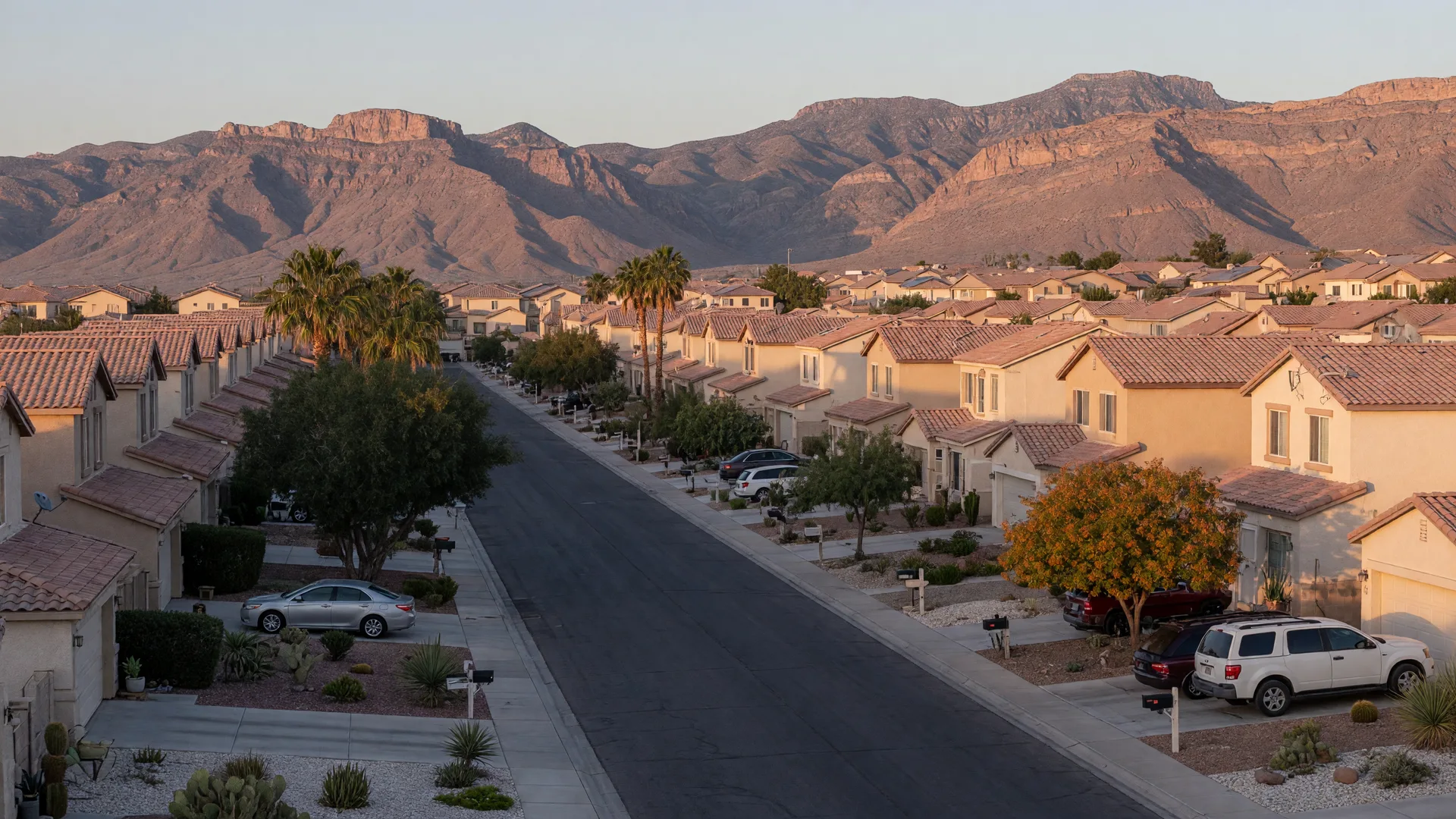
The 2020-2021 cohort locked in mortgage rates around 3%. Moving today means trading that payment for a materially higher rate on a similar loan amount. For many owners, that math makes staying put far more attractive than selling.
So instead of listing, a large share of homeowners remodel, add on, or simply stay. This freezes resale inventory and keeps supply artificially low. It is one of the strongest reasons Las Vegas prices have not dropped the way some expected: the people who would normally be selling into a hot market are choosing not to.
Reason 3: Geographic and Federal Land Constraints
More than 85% of the land in Clark County is federally managed, largely by the Bureau of Land Management. That caps the supply of developable acreage and slows how fast new master-planned communities can scale. Builders simply cannot sprawl the way they can in flatter, less-constrained metros.
When new construction is limited, the market depends more heavily on resale inventory. And as Reason 2 shows, that resale inventory is being withheld. Land constraints sit underneath the whole picture: they are why the valley cannot simply expand outward to relieve the pressure on prices.
Reason 4: Steady In-Migration and a Diversifying Economy
Las Vegas is no longer a tourism-only town. Ongoing job diversification, sports and entertainment expansion, and a steady flow of out-of-state buyers keep a high demand floor under prices. People are not just visiting; they are moving here, and they are buying homes.
Relocation from states with higher costs and taxes continues to feed the market, and the growing employment base gives those new residents a reason to stay. That durable demand is the final leg of the stool that keeps prices from falling.
Pro-Tips for Buyers and Sellers in 2026
- Buyers should focus on monthly payment capability and loan structure rather than trying to time a crash.
- Sellers should price from current comparable-sale data, not emotion, because overpricing makes a home sit.
- Both sides should use neighborhood-level local data rather than generic national headlines.
Common Pitfalls to Avoid
- Waiting on the sidelines for a 2008-style correction when lending standards and supply dynamics are different today.
- Ignoring closing costs, escrow, HOA transfer fees and property taxes when running your numbers.
- Applying other-metro rules to the Las Vegas Valley, which has its own land, supply and demand picture.
- Overpricing from emotional attachment rather than current comps, which leaves a home sitting in a market that rewards accurate pricing.
What Does This Mean for You? A Buyer and Seller Perspective
If prices are not dropping, the path forward is the same for buyers and sellers: make decisions from evidence, not headlines. A clear-eyed process looks like this:
- 1Review your financial baseline with a local mortgage professional so you know what you can actually afford and what your true monthly cost looks like.
- 2Define your non-negotiables versus cosmetic upgrades, so you compare homes on the things that matter, not the finishes you can change.
- 3Review recent closed comps in your target subdivision rather than relying on stale valuation-site estimates.
- 4Work with an agent who understands both appraisal fundamentals and current market data, so the numbers behind your decision are sound.
FAQ: Las Vegas Home Prices in 2026
Q: Are Las Vegas home prices expected to drop later this year?
A: Current indicators, including tight inventory, steady in-migration and a strong demand floor, point to prices holding near record levels or seeing modest appreciation rather than a significant drop, though markets can shift.
Q: How does federal land ownership affect Las Vegas housing prices?
A: With the large majority of Clark County land under federal management, developable acreage is limited, which constrains new supply and supports prices.
Q: Is it a good time to buy a home in Las Vegas?
A: If you plan to stay several years, buying now lets you own before any further appreciation, with the option to refinance if rates decline. Your personal timeline and finances should drive the decision.
Q: How does the mortgage rate lock-in affect home prices?
A: Millions of owners with 2020-2021-era low rates are reluctant to sell and re-borrow at higher rates, sharply limiting resale listings and supporting prices.
Q: What role does an appraiser background play when buying or selling?
A: It means rigorous valuation discipline, understanding what truly drives a home's value, so you do not overpay as a buyer or underprice as a seller. Paired with current market data and AI tools, it gives you a clear edge.
Get the specific read for your situation
Get your free market analysis and book a private strategy session to see how today's Las Vegas market fits your situation: Free Market Analysis · Book a Private Strategy Session.
Sandy Margolin, REALTOR® | Certified AI Agent | 36+ years in real estate | approximately 20 years prior experience as a licensed residential real estate appraiser | Nevada license S.0072707
Related Sandy Margolin resources

Written by
Sandy Margolin
REALTOR · Certified AI Agent · 36+ years in real estate · former appraiser · Nevada license S.0072707.
More about SandyWant to know where the market sits for your move?
The article reads the general trend. The conversation reads yours, with current numbers and a straight answer.